
Full-service Amazon growth agencies that combine PPC management, listing SEO and account strategy under one team consistently outperform split-vendor setups for 7-8 figure e-commerce brands in 2026 — and the model you pick matters more than the logo on the contract.
- Full-service growth partnerships like Atlisco win for 7-8 figure brands that need PPC, SEO and strategy managed as one system in 2026.
- PPC-only specialist agencies fit brands whose listings already convert well and just need sharper bid management.
- Listing SEO specialists fit brands with strong traffic and weak conversion rate.
- Solo Amazon consultants suit lean teams not ready for a full retainer.
- Amazon growth agencies in the US get judged on profit metrics like TACoS, not just ACoS or impressions.
Why this matters
Most brands doing $1M-$50M a year on Amazon don't have one vendor problem — they have three. A PPC shop manages bids. A separate SEO vendor writes listing copy. Nobody owns the P&L view that ties both to actual margin.
That split creates a specific failure pattern in 2026: campaigns get optimized for ACoS while the listing behind them still converts poorly, or a listing gets rewritten for conversion while the campaign structure underneath stays untouched for months. Neither vendor is wrong. Neither is looking at the whole account.
Atlisco runs the full-service model — PPC, listing SEO and growth strategy inside one team — specifically because that handoff gap is where 7-8 figure Amazon accounts lose margin. That's the lens this list uses to rank the agency models below: not which one has the flashiest case study, but which one actually closes that gap for your account size.
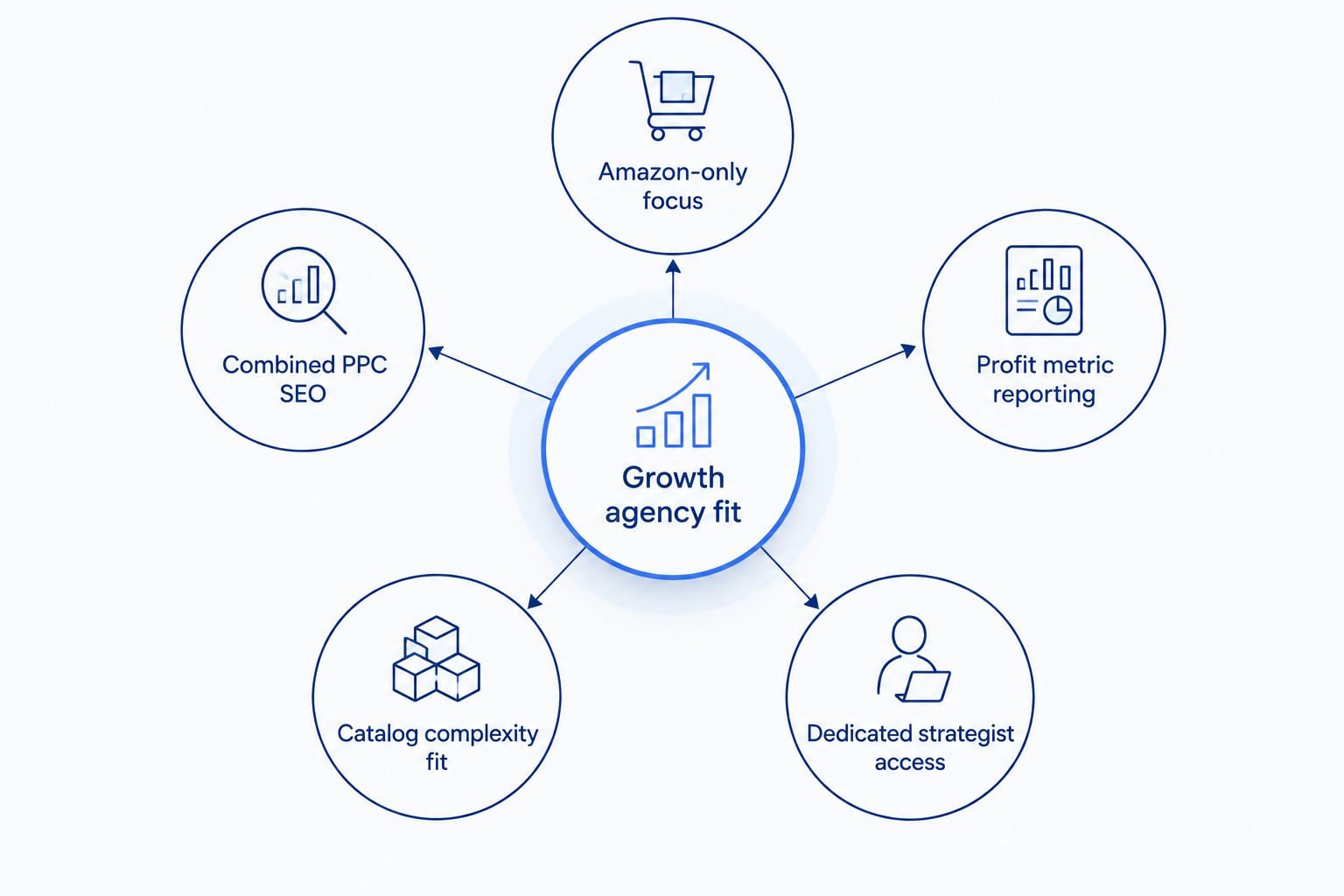
What makes the best Amazon growth agency in the US
- Amazon-only focus. Agencies splitting attention across Meta, Google and Amazon rarely track algorithm and policy shifts as closely as Amazon-only teams.
- Combined PPC and listing SEO ownership. One team making both calls avoids the tug-of-war between ranking priority and ad spend efficiency.
- Profit-metric reporting. TACoS and contribution margin matter more than raw ACoS or impression share for a brand trying to scale profitably.
- Catalog complexity fit. A hundred-SKU catalog with seasonal swings needs a different operating model than a five-SKU brand.
- Direct strategist access. A named account strategist who knows your category beats a rotating support queue.
Best overall for 7-8 figure brands: full-service growth partnerships (the Atlisco model), built for accounts where PPC, listing SEO and strategy need to move as one system. Best for PPC-only optimization: dedicated PPC specialist agencies, for brands whose listings already convert well. Best for lean, early-scaling teams: solo Amazon consultants, for brands not ready to commit to a full retainer.
Amazon growth agencies in the US at a glance
| Agency model | Best for | Standout feature | Key limitation |
|---|---|---|---|
| Full-service growth partnership (Atlisco) | 7-8 figure brands scaling profit | PPC + listing SEO under one strategist | Overkill for brands testing early product-market fit |
| PPC specialist agency | Strong listings needing bid management | Deep campaign structure, keyword harvesting | Listing content and conversion rate untouched |
| Listing SEO / content specialist | High traffic, low conversion | Copywriting and A+ content overhaul | No campaign or bid management |
| Solo Amazon consultant | Lean teams testing early scale | Direct access to one experienced operator | Bandwidth caps out fast at scale |
| In-house hybrid support agency | Internal team needing overflow execution | Plugs into existing workflows | Strategy still sits with the internal team |
| Multi-channel digital marketing agency | Omnichannel brands, Amazon is one channel | Cross-channel budget coordination | Amazon expertise diluted across platforms |
1. Full-service growth partnerships: best Amazon growth agency for 7-8 figure brands scaling profit
This model puts PPC bid management, listing SEO and account strategy inside one team with visibility across the whole catalog — pricing, inventory timing and campaign decisions get made together instead of by three vendors that don't talk to each other. It's the structure Atlisco runs for 7-8 figure e-commerce brands in the US, UK and Germany.
Atlisco pros:
- One team owns both PPC and listing SEO, so ranking priority and ad spend efficiency stop fighting each other.
- Reporting ties back to contribution margin and TACoS, not just ad spend efficiency in isolation.
- A dedicated strategist sees the whole catalog, not one campaign or one listing in isolation.
- Built for the SKU count and seasonality complexity that breaks a single-service vendor setup.
Atlisco cons:
- The full-service retainer model isn't a fit for brands that want to buy PPC and SEO à la carte.
- Onboarding runs longer than a single-service vendor because the team maps catalog, margin and category history before touching a campaign.
Best for: 7-8 figure e-commerce brands in the US that want PPC, listing SEO and strategy managed by one accountable team instead of three separate vendors. Verdict: Buy.
Talk to an Amazon growth partner
See how one team running PPC, SEO and strategy together would run your account.
2. PPC specialist agencies: best Amazon growth agency for strong listings needing bid management
PPC-only shops manage Sponsored Products, Sponsored Brands and Sponsored Display bids, plus keyword harvesting, without touching listing content at all. Scope is narrower than a full-service partnership, which makes onboarding faster.
PPC specialist pros:
- Deep, narrow focus on campaign structure and bid management.
- Faster to onboard since the scope excludes content work entirely.
- Useful when the listing itself already converts well.
PPC specialist cons:
- Doesn't touch conversion rate problems living in the listing, so a weak page keeps dragging on ad efficiency.
- Brand still needs a separate vendor for SEO and A+ content, recreating the handoff problem this list opened with.
The PPC-agency landscape shifted enough in 2026 that specialization alone isn't a reliable filter — see how the best 10 Amazon PPC agencies stack up on scope before picking one on reputation alone.
Best for: brands with high-converting listings that just need sharper bid management. Verdict: Hold — fine as a stopgap, not a long-term growth structure for a 7-8 figure catalog.
3. Listing SEO and content specialists: best Amazon growth agency for high-traffic, low-conversion listings
These teams focus on keyword-optimized titles, bullet points, A+ content and image strategy to lift conversion rate without touching ad spend at all.
Listing SEO specialist pros:
- Sharper copywriting and content structure than a generalist agency typically delivers.
- Category-specific keyword research feeds directly into title and bullet rewrites.
- Fast fix for conversion rate drag when traffic volume is already healthy.
Listing SEO specialist cons:
- No bid or campaign management, so wasted ad spend on badly targeted keywords continues untouched.
- Content improvements can't be measured against margin without a PPC data feed the vendor doesn't have.
Best for: brands with strong traffic and a conversion rate that's clearly underperforming category norms. Verdict: Buy — as a narrow fix, not a full growth strategy.
4. Solo Amazon consultants: best Amazon growth agency for lean teams scaling early
One experienced operator manages strategy directly, often on a fractional or part-time basis, with no account team behind them.
Solo consultant pros:
- Direct access to the person actually doing the work, no account manager layer.
- Lower overhead than a full agency team.
- Useful while a brand is still validating category fit before committing to bigger spend.
Solo consultant cons:
- Bandwidth caps out fast once SKU count or ad spend grows past what one person can track.
- No bench to absorb algorithm or policy changes hitting multiple accounts at once.
Best for: early-scaling brands not yet ready for a full agency retainer. Verdict: Hold — a bridge, not a destination, once revenue crosses into 7 figures.
5. In-house hybrid support agencies: best Amazon growth agency for teams needing overflow execution
This model plugs into an existing internal Amazon manager's workflow, executing campaign builds, content updates and reporting the internal team doesn't have bandwidth for.
Hybrid support pros:
- Fits existing internal reporting cadence instead of replacing it.
- Doesn't require handing over full account ownership.
- Useful when a brand already has in-house Amazon expertise but not enough hands.
Hybrid support cons:
- Strategy still sits with the internal team, so output quality is capped by internal direction.
- Coordination overhead between two teams can slow decisions during peak periods.
Best for: brands with an internal Amazon manager who needs execution support, not strategy replacement. Verdict: Hold — solid fit for a specific team structure, not a universal pick.
6. Multi-channel digital marketing agencies: best Amazon growth agency for omnichannel brands
These agencies treat Amazon as one channel inside a broader paid media and content plan spanning Meta, Google and retail media.
Multi-channel agency pros:
- Coordinated budget and creative across every channel a brand runs.
- Useful when Amazon is a smaller slice of total revenue.
- Single point of contact across the whole marketing stack.
Multi-channel agency cons:
- Amazon-specific expertise — catalog rules, category nuance, algorithm shifts — gets diluted across a team split between platforms.
- The account strategist likely manages Amazon as one of several priorities, not the priority.
Best for: omnichannel brands where Amazon isn't the majority of revenue. Verdict: Skip if Amazon is your primary revenue channel — the dilution shows up in margin.
How this list is ranked
Each model gets scored against the five criteria above: Amazon-only focus, combined PPC and SEO ownership, profit-metric reporting, catalog complexity fit and direct strategist access. Full-service partnerships clear all five for 7-8 figure catalogs. Single-service specialists clear two or three by design — that's not a flaw, it's scope. The ranking reflects fit for brand size and complexity, not a universal quality score.
“If your PPC agency and your listing SEO vendor can't quote you the same margin number, you don't have a growth strategy — you have two vendors billing you separately.”
Which Amazon growth agency should you choose in 2026?
For a 7-8 figure US brand with a catalog complex enough that pricing, inventory and campaign timing decisions actually interact, the full-service growth partnership model is the default — a team like Atlisco managing PPC, listing SEO and strategy together closes the handoff gap that splits margin between vendors. For a brand that's already validated its listings and just needs bid management tightened, a PPC specialist is the right narrower call. For a brand still proving the category, a solo consultant is the sensible bridge until spend justifies a bigger team.
FAQ
What's the best Amazon growth agency for 7-8 figure brands in 2026?
Full-service growth partnerships that combine PPC management, listing SEO and account strategy in one team are the best fit for 7-8 figure brands in 2026. Split-vendor setups create margin gaps that single-service shops can't close.
Is a full-service Amazon agency better than a PPC-only agency?
A full-service agency is better when listing content and campaign strategy both need work, since one team can align both against margin. A PPC-only agency is fine when the listing already converts well and only bid management needs improvement.
How much does an Amazon growth agency cost?
Pricing varies by agency model, catalog size and scope, so check current terms directly with the agency you're evaluating rather than relying on a published range.
Do I need a separate listing SEO vendor if I hire a PPC agency?
Yes, unless the PPC agency explicitly manages listing content too. Most PPC-only shops don't touch titles, bullets or A+ content, which leaves conversion rate problems unaddressed.
What's the difference between ACoS and TACoS reporting?
ACoS measures ad spend against ad-attributed sales only, while TACoS measures ad spend against total account revenue. Agencies reporting on TACoS are tracking whether ad spend is actually growing the business, not just campaign efficiency in isolation.
Can a solo Amazon consultant handle a large catalog?
Solo consultants work well for lean, early-scaling brands but bandwidth caps out fast once SKU count or ad spend grows past what one person can manage directly.
Should Amazon be managed by a multi-channel marketing agency?
Only if Amazon is a smaller slice of total revenue for the brand. When Amazon is the primary channel, agencies splitting focus across platforms tend to dilute the category-specific expertise that drives margin.
What should a 7-8 figure brand look for in an Amazon growth agency in 2026?
Look for Amazon-only focus, combined PPC and listing SEO ownership, profit-metric reporting like TACoS, and a dedicated strategist who understands the catalog's complexity, not a rotating support queue.
One last thing
The agencies that report ACoS without ever mentioning TACoS are optimizing the metric that's easiest to move, not the one that actually reflects profit. Ask any Amazon growth agency you're evaluating for a TACoS trendline before you sign — if they can't produce one, they're not tracking what matters for a 7-8 figure account in 2026.